
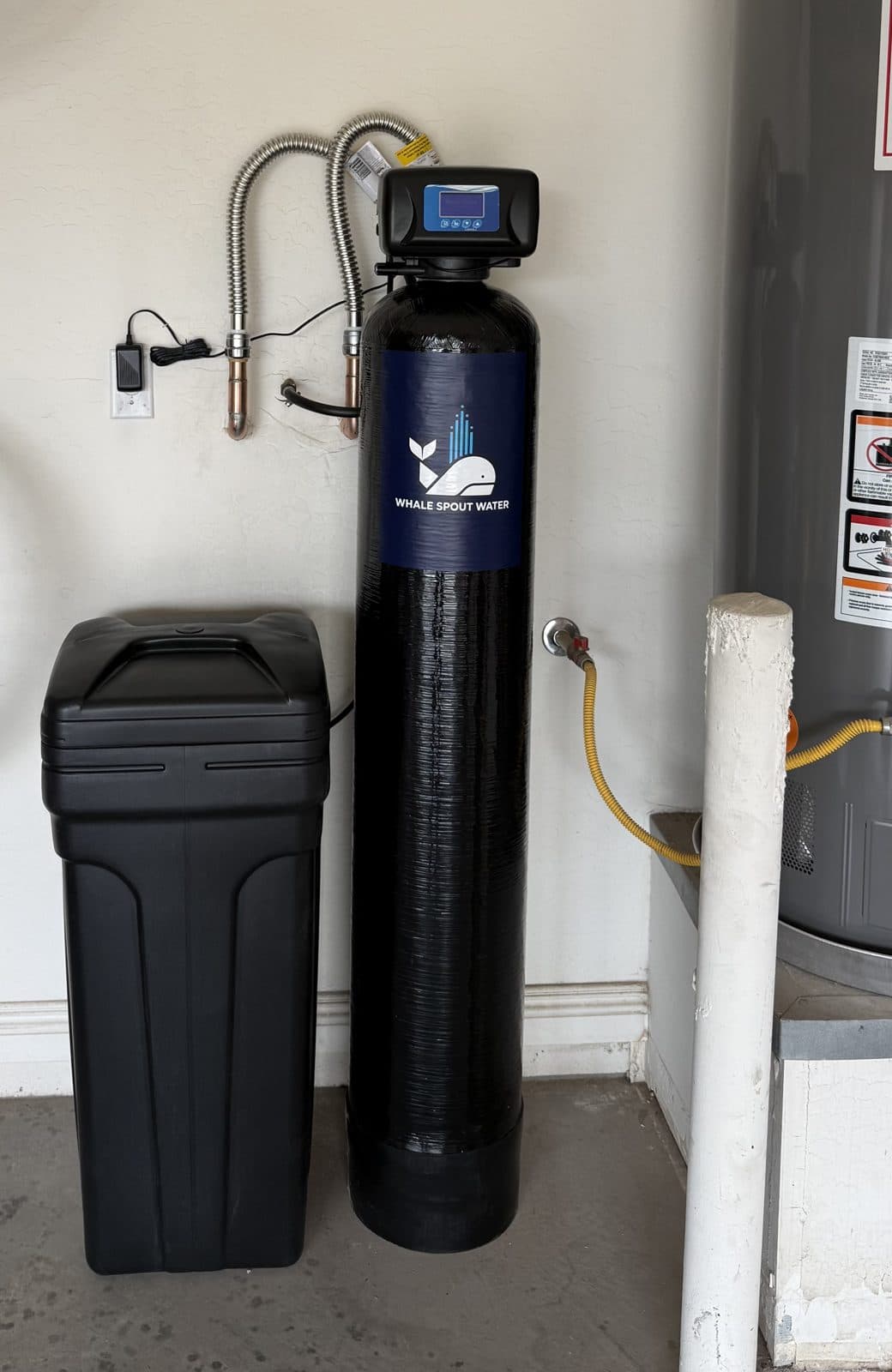
For most Phoenix-area families, the right water softener holds 1 to 2.5 cubic feet of resin, often sold as a 32,000- to 80,000-grain unit. The exact size depends on two numbers: how hard your water is and how many people live in your home. A family of four on City of Phoenix water, for example, needs roughly 1.5 cubic feet (a 48,000-grain class softener).
Below is the formula installers use, a sizing chart for cities across the valley built from each utility's own published hardness data, and the hardness setting to use once your system is in. I'm Peter Whalen, owner of Whale Spout Water, and sizing is the part of a softener purchase I see go wrong most often, so this is the guide I wish every homeowner read first.
The Quick Answer: Water Softener Size by Household
- 1–2 people: 1 cubic foot of resin (often sold as a 32,000-grain softener) for most cities
- 3–4 people: 1.5 cubic feet (48,000-grain class) in most of the valley; 2 cubic feet in the hardest areas
- 5–6 people: 2 to 2.5 cubic feet (64,000- to 80,000-grain class)
Those are starting points. The rest of this guide shows how to check them against your city's actual hardness.
Step 1: Find Your Water Hardness
Water hardness is measured in grains per gallon (GPG). The USGS classifies water above 10.5 GPG as "very hard," and most of the Phoenix metro is above that line. Hardness varies a lot by city, and sometimes by neighborhood, so start with your utility's published number. For sizing, use the high end of the range, since that's the water your softener has to handle on its hardest days.
| City | Published hardness | Use for sizing | Source |
|---|---|---|---|
| Phoenix, Ahwatukee, Laveen | 10–17.6 GPG | 18 | City of Phoenix 2025 report |
| Scottsdale | 16–25 GPG by area | 18 north of Chaparral; 25 south of Indian School | Scottsdale Water |
| Mesa | 12–22 GPG | 22 | City of Mesa |
| Chandler | 5–20 GPG (16.5 average) | 20 | City of Chandler |
| Fountain Hills | About 18 GPG | 18 | EPCOR |
| Tempe | 11–17 GPG (13.5 average) | 17 | City of Tempe |
| Peoria | 13–17 GPG (treatment plant water) | 17 | City of Peoria |
| Queen Creek | 6–17 GPG | 17 | Town of Queen Creek |
| Paradise Valley | About 12 GPG (EPCOR areas) | 12 | EPCOR |
| Gilbert | 8–10 GPG average | 12 (the town recommends 10–12) | Town of Gilbert |
| Sun City | 7–11 GPG | 11 | EPCOR |
If your city isn't listed (Glendale, Buckeye, Goodyear, Avondale, Surprise, Litchfield Park, Carefree, or Cave Creek), hardness varies by provider and neighborhood. Check your utility's annual water quality report or use a test kit. Our full table lives on the Phoenix water quality page.
Step 2: Estimate Your Daily Indoor Water Use
The standard sizing assumption is 75 gallons per person per day for indoor use. Showers, toilets, laundry, the dishwasher, and the kitchen sink all count.
Outdoor water doesn't. Irrigation lines and hose bibs are normally left off the softener loop, and in the desert that's a big share of what your meter reads: Scottsdale Water estimates about 70 percent of residential water use in the city goes outdoors. If you size a softener off your full water bill, you'll badly oversize it.
Step 3: Do the Math
The formula is simple:
People × 75 gallons × hardness (GPG) = grains removed per day
Multiply that by 7 to get your weekly load. A well-sized softener should handle about a week between regenerations.
Then match the weekly load to resin volume. Here's the part most shoppers miss: a softener's "grain" rating (32,000, 48,000, and so on) is measured at the maximum salt setting, which wastes salt. At an efficient everyday salt setting, plan on roughly 25,000 grains per cubic foot of resin:
| Weekly grain load | Resin volume | Often sold as |
|---|---|---|
| Up to 25,000 | 1 cu ft | 32,000-grain |
| 25,000–37,500 | 1.5 cu ft | 48,000-grain |
| 37,500–50,000 | 2 cu ft | 64,000-grain |
| 50,000–62,500 | 2.5 cu ft | 80,000-grain |
Water Softener Sizing Chart by City
Here's the math already done, using the sizing hardness from Step 1 and 75 gallons per person per day. Numbers are grains per day, with the weekly load in parentheses.
| City (sizing hardness) | 2 people | 4 people | 6 people |
|---|---|---|---|
| Phoenix (17.6) | 2,640 (18,480) | 5,280 (36,960) | 7,920 (55,440) |
| Scottsdale, north (18) | 2,700 (18,900) | 5,400 (37,800) | 8,100 (56,700) |
| Scottsdale, south (25) | 3,750 (26,250) | 7,500 (52,500) | 11,250 (78,750) |
| Mesa (22) | 3,300 (23,100) | 6,600 (46,200) | 9,900 (69,300) |
| Chandler (20) | 3,000 (21,000) | 6,000 (42,000) | 9,000 (63,000) |
| Fountain Hills (18) | 2,700 (18,900) | 5,400 (37,800) | 8,100 (56,700) |
| Tempe, Peoria, Queen Creek (17) | 2,550 (17,850) | 5,100 (35,700) | 7,650 (53,550) |
| Paradise Valley, Gilbert (12) | 1,800 (12,600) | 3,600 (25,200) | 5,400 (37,800) |
| Sun City (11) | 1,650 (11,550) | 3,300 (23,100) | 4,950 (34,650) |
A weekly load above about 62,500 grains (a family of six in south Scottsdale or Mesa, for example) is the point where a single 2.5 cubic foot tank regenerates more often than once a week. For those homes, a larger tank or a twin-tank system is worth discussing.
Three Worked Examples
A family of four in Chandler
4 × 75 × 20 GPG = 6,000 grains a day, or 42,000 a week. That calls for 2 cubic feet of resin (64,000-grain class). Sized at Chandler's 16.5 GPG average instead, the same family would land at about 34,650 grains a week and a 1.5 cubic foot unit, which would struggle on Chandler's harder days.
A couple in central Phoenix
2 × 75 × 17.6 GPG = 2,640 grains a day, or about 18,500 a week. A 1 cubic foot softener (32,000-grain class) handles that comfortably with room to spare.
A family of four in Gilbert
4 × 75 × 12 = 3,600 grains a day, or 25,200 a week. That sits right at the line between 1 and 1.5 cubic feet. Go with 1.5 cubic feet: it leaves headroom for guests and seasonal swings without meaningfully oversizing.
What Happens If You Get the Size Wrong
Too small
An undersized softener runs out of capacity fast. It regenerates every day or two, which burns through salt and sends extra water down the drain, and during heavy use (back-to-back showers plus laundry) hard water can slip through before the next regeneration. This is the most common mistake in DIY installs.
Too big
An oversized softener isn't harmful, but it's money spent for nothing. You pay more up front for resin you never use, and on a time-based valve, an oversized system can regenerate on a schedule it doesn't need. With a modern metered valve, oversizing is mostly a cost issue.
The sweet spot
A softener that regenerates about once a week, on a metered valve that counts actual water use, uses salt efficiently and always has capacity in reserve.
What to Set Your Water Softener's Hardness To
Once installed, a metered softener needs one number from you: your water hardness in GPG. Use the high end of your utility's range so the system never runs short:
- Phoenix, Ahwatukee, Laveen: about 18 (the city reports 10–17.6)
- Scottsdale: 18 north of Chaparral Road, 22 between Indian School and Chaparral, 25 south of Indian School
- Gilbert: 10–12, per the Town of Gilbert's own recommendation
- Chandler: 20 (the city's high end)
- Mesa: 22 (the city's high end)
Setting it a little high costs a small amount of extra salt. Setting it too low lets hard water through. When in doubt, round up, or test your water at the tap.
Salt-Free Conditioners Don't Work This Way
Everything above applies to salt-based (ion exchange) softeners. Salt-free conditioners don't remove hardness, so they aren't sized by grains. They're sized by your home's peak flow rate, mostly a function of how many bathrooms you have. If you're weighing the two, our softener vs. salt-free conditioner guide covers the trade-offs.
The Bottom Line
Size your softener on three numbers: the people in your home, 75 gallons per person per day, and the high end of your city's published hardness. For most Phoenix-area families of four that lands at 1.5 to 2 cubic feet of resin, and a properly sized system should regenerate about once a week.
If you'd rather not do the math, that's what our free 15-minute consult is for. We'll size the system to your household and your water, and if you're in a city that doesn't publish a single hardness number, we'll test it. Whole-home salt softeners from Whale Spout Water are $3,399 fully installed with a lifetime warranty. See all pricing, or read how hard Phoenix tap water really is.